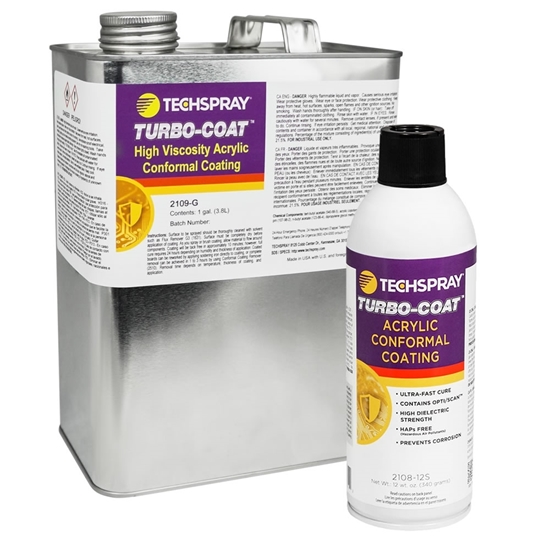
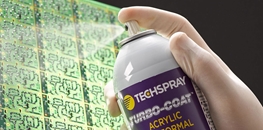
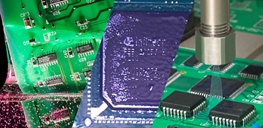
Turbo-Coat Acrylic Conformal Coating

Acrylic Conformal Coating with the fastest cure, dry to touch in 3 minutes!

Part # Name Size Units
Per Case
Price
Per Case
Case
Qty
 
2108-12S 12oz aerosol 12 oz (340g) 12 $412.08
2108-P Stnd viscosity - 1pt liquid 1 pt (473mL) 2 $75.92
2108-G Stnd viscosity - 1 gal liquid 1 gal (3.8L) 1 $194.79
2108-5G Stnd viscosity - 5 gal liquid 5 gal (19L) 1 $771.09
2109-P High viscosity - 1pt liquid 1 pt (473mL) 2 $98.68
2109-G High viscosity - 1 gal liquid 1 gal (3.8L) 1 $253.23
2109-5G High viscosity - 5 gal liquid 5 gal (19L) 1 $1,002.58
Packaging Order minimum case quantity only. Extra shipping fees may apply.
Order from an authorized distributor
Turbo-­Coat Acrylic Conformal Coating is designed to speed up board production throughput without additional investment of expensive UV systems or other capital equipment. Conformal coating cure time is often considered a production bottleneck for PCB assembly operations. Turbo­Coat (standard viscosity) dries tack­free in 3 minutes, allowing manufacturers to handle boards in 1/3 the time of the leading acrylic coating! Full cure can be achieved as quickly as 10 minutes with elevated temperatures.

Acrylic conformal coating is recognized for its high dielectric strength, and fair moisture and abrasion resistance. What generally distinguishes acrylic coating from other resins is ease of removal. Acrylic coatings are easily and quickly removed by a variety of solvents, often without the need of agitation. This makes rework and even field repair very practical and economical. 

For more information, check out our Essential Guide to Conformal Coating.


Turbo-Coat comes in 2 viscosities:
Standard - 10-20cps
High viscosity - 52-60cps


Features & Benefits

  • Fastest cure – dry to touch in 3 minutes!
  • Low toxicity
  • No Toluene, Xylene or MEK
  • UL94 V-0 rated – nonflammable final coat
  • Fast & easy rework & repair
  • UV indicator for black light QC inspection

Specifications: IPC-CC-830B, UL94 V-0

Applications


FAQ's

What is the difference between full cure and tack-free cure?

Full cure is when it meets all the final specifications. There might be some out-gassing, but it will be as hard as it is going to be, and adhesion is as good as it gets.  Tack-free is as the name suggests, not sticky so you can move it along the assembly process.

What is the difference between dielectric strength and dielectric withstand voltage?

The dielectric strength is material intrinsic property and withstand voltage is surface property which depend on thickness of the material. They can be slightly different for thicker materials, but for conformal coating, the two numbers should be very close or the same. That is because we test coating at 3-5 mils thickness, calculate, then report the value per mil.

What type of UV light / black light should I use for QC inspection of the final conformal coating?
Conformal coating with UV tracer can be inspected with any typical UV lamp which has wavelength of 320-380 nm.

Articles

VIDEO: Conformal Coating Frequently Asked Questions
Join Nicole Bass, Techspray Product Manager, as she addresses common conformal coating queries. Safeguard electronics effectively w/ expert insights.
Read This Post

WEBINAR: Conformal Coating Defects -- How To Diagnose, Repair & Prevent
Applying conformal coating without defects like bubbles, ripples, and open areas can be challenging. Techspray and PVA discuss how to diagnose and prevent defects and improve production throughput and final device reliability.
Read This Post

Top 10 Mistakes When Spraying Conformal Coating on a Printed Circuit Board Assembly
In this article, we will explore the top 10 mistakes to avoid when spraying conformal coating on a circuit board. By identifying and understanding these common mistakes, you can ensure that your conformal coating process is successful and your electronic components are protected.
Read This Post

More Articles
You did not finish submitting your information to request a sample