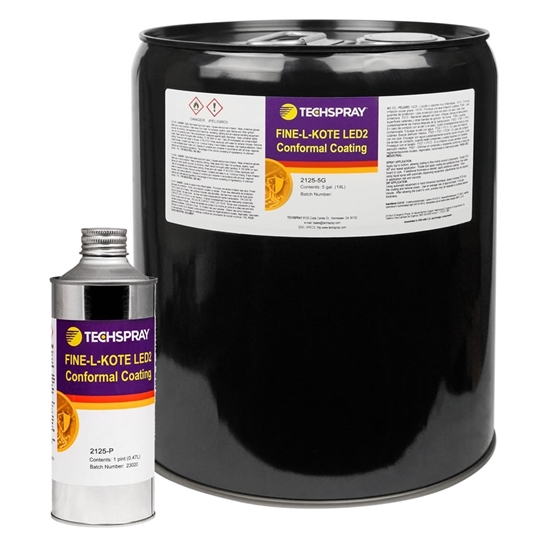



Fine-L-Kote LED2 Silicone Coating

Silicone conformal coating designed to coat over LEDs

Request A Sample
Part # Name Size Units
Per Case
Price
Per Case
Case
Qty
 
2125-P Fine-L-Kote LED2 - 1 pint 1 pt (473mL) 2 $146.84
2125-5G Fine-L-Kote LED2 - 5 gal 5 gal (19L) 1 $2,394.28
Packaging Order minimum case quantity only. Extra shipping fees may apply.
Order from an authorized distributor

Fine-L-Kote™ LED2 is specifically designed and formulated for light emitting diode applications, where a completely transparent coating is required to provide a tough, extremely flexible protective coating.  It provides the highest flexibility for extreme temperatures on the flex and rigid circuitry found on LED displays and provides an outstanding non-stick surface for soil repellency. 

Cured coatings are hydrolytically stable and retain their physical electrical properties after high temperature and humidity exposure, without interfering with light wavelength or intensity.  Fine-L-Kote LED2 will not stress delicate circuit components and meets the performance parameters (without UV traceability) of MIL-I-46058C, Type SR but is not qualified on QPL-46058.

Silicone conformal coating provides excellent protection in a very wide temperature range. SR provides good chemical resistance, moisture and salt spray resistance, and is very flexible. Silicone conformal coating isn’t abrasion resistant because of its rubbery nature, but that property does make it resilient against vibrational stresses. Silicone coatings are commonly used in high humidity environments, like outdoor signage. 


Features & Benefits

  • Transparent to visible wavelengths, will not block or change light intensity or wavelength
  • Exceptional dirt, dust, and soil repellency; surfaces remain clean longer
  • Extends component life by protecting against adverse environments
  • Good insulation properties help with circuit insulation characteristics,
  • Excellent flexibility minimizes thermal stress
  • Resists moisture, salt, fungus, corrosive vapors, and severe environments
  • Engineered to withstand the heat generated by electronic circuitry as well as climatic temperature extremes
  • Passes Cree Coating Chemical Compatibility for Direct and Proximity Testing, MX-6 and XP-E
  • Meets IPC-CC-830B
  • UL 94 V-0
  • Room temperature moisture cure can be heat accelerated
  • RoHS compliant

Ideal for...

  • LED Displays and controls
  • Data Communications
  • Instrumentation
  • Automotive Manufacturing
  • Marine Manufacturing
  • Process Control

Applications


FAQ's

What is the difference between full cure and tack-free cure?

Full cure is when it meets all the final specifications. There might be some out-gassing, but it will be as hard as it is going to be, and adhesion is as good as it gets.  Tack-free is as the name suggests, not sticky so you can move it along the assembly process.

What does 2-step curing mean?
That just means you break the accelerated curing process into 2 stages. You basically ramp up the heat so the coating has an opportunity to level. Otherwise, you can get a wrinkling or orange peel texture. That texture doesn’t affect performance, just aesthetic. This is not an issue when curing in ambient conditions.
What is the difference between dielectric strength and dielectric withstand voltage?

The dielectric strength is material intrinsic property and withstand voltage is surface property which depend on thickness of the material. They can be slightly different for thicker materials, but for conformal coating, the two numbers should be very close or the same. That is because we test coating at 3-5 mils thickness, calculate, then report the value per mil.

Articles

VIDEO: Conformal Coating Frequently Asked Questions
Join Nicole Bass, Techspray Product Manager, as she addresses common conformal coating queries. Safeguard electronics effectively w/ expert insights.
Read This Post

WEBINAR: Conformal Coating Defects -- How To Diagnose, Repair & Prevent
Applying conformal coating without defects like bubbles, ripples, and open areas can be challenging. Techspray and PVA discuss how to diagnose and prevent defects and improve production throughput and final device reliability.
Read This Post

Top 10 Mistakes When Spraying Conformal Coating on a Printed Circuit Board Assembly
In this article, we will explore the top 10 mistakes to avoid when spraying conformal coating on a circuit board. By identifying and understanding these common mistakes, you can ensure that your conformal coating process is successful and your electronic components are protected.
Read This Post

More Articles
You did not finish submitting your information to request a sample